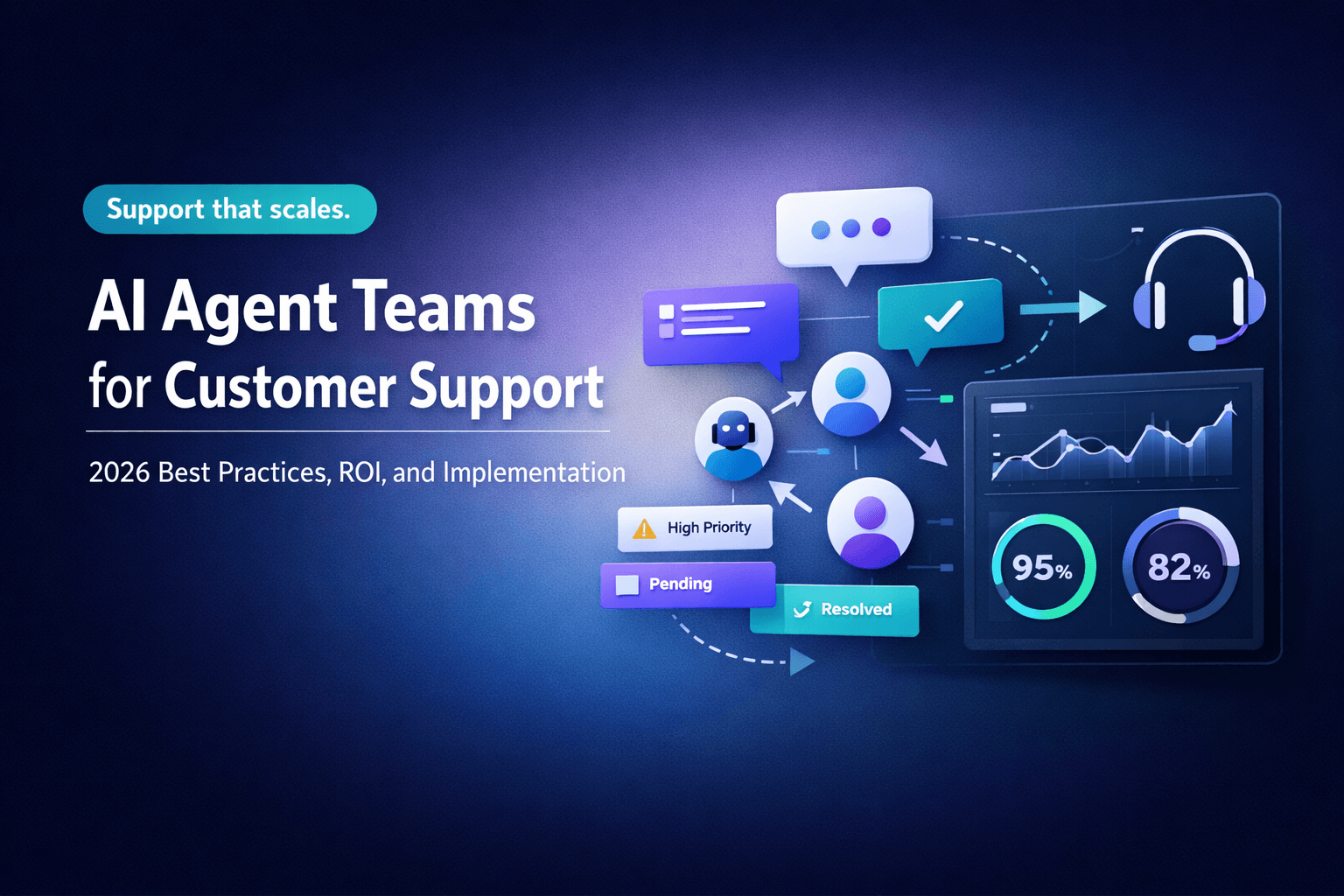
AI Agent Teams for Customer Support: 2026 Best Practices, ROI, and Implementation
Learn how AI agent teams are changing customer support in 2026, what results companies are reporting, and how to roll out a practical pilot.
Customer support has moved past the single chatbot
For years, companies asked chatbots to do one job: reduce ticket volume.
That goal now feels too small.
In 2026, the bigger opportunity is using coordinated AI agent teams to actually solve customer problems from start to finish. Instead of answering a single FAQ and sending the user elsewhere, these systems can triage an issue, pull the right context, complete approved actions, and escalate to a human when needed.
That shift is showing up in the numbers. Recent 2026 industry and vendor reports on AI customer service and AI agents for customer support suggest well-scoped agent teams can autonomously resolve roughly 60 to 80 percent of support tickets in the right environments. Those same reports point to faster first-response times, lower cost per ticket, and shorter payback periods when companies start with high-volume, low-risk workflows.
The takeaway is simple: the most effective support teams are no longer asking, "Should we add a bot?" They are asking, "Which parts of the support journey can an AI team own safely and well?"
What AI agent teams actually are
An AI agent team is a group of specialized agents that work together instead of relying on one general-purpose bot to do everything.
In a support setting, that often looks like this:
- A triage agent identifies the issue, urgency, and customer intent.
- A knowledge agent pulls the right help center article, policy, or product documentation.
- An action agent completes approved tasks like password resets, refunds, order updates, or account changes.
- An escalation agent hands the case to a human with full context when the situation requires judgment, empathy, or exception handling.
This matters because support work is rarely one-dimensional. A billing issue may involve policy, account data, security checks, and a customer conversation that spans several messages. A one-bot setup often struggles there. A coordinated team can divide the work, pass context forward, and keep the interaction moving.
That is the core difference between older chatbots and modern multi-agent support. Traditional bots were built mainly for deflection. AI agent teams are built for resolution.
Platforms such as AffinityBots are part of this shift. They give teams a way to design roles, connect tools, and manage workflows without building every step from scratch.
Where the ROI really comes from
The strongest business case for AI agent teams is not just labor reduction. It is operational leverage.
Here is where companies tend to see the payoff:
1. Faster response times
Customers do not want to wait hours for a status update or a simple account fix. AI agents can work around the clock, across channels, and in multiple languages. Reports on scalable end-to-end AI service agents consistently point to response times dropping from hours to seconds when common workflows are automated well.
2. Lower cost per resolved ticket
When a team can automate repetitive Tier 1 and part of Tier 2 support, every human agent becomes more valuable. Instead of spending time on routine requests, people can focus on edge cases, retention risks, and higher-value conversations. Some 2026 forecasts, including a widely cited contact center savings projection, estimate very large savings if adoption continues at its current pace.
3. Better customer experience
Customers care less about whether a human or AI handled the request than whether the issue was resolved quickly and correctly. Fast, accurate resolution with a clean escalation path usually beats a long back-and-forth with a script-bound support queue.
4. Faster ramp for growing teams
Agent teams can also absorb spikes in volume without forcing companies into a hiring scramble. That matters for seasonal businesses, high-growth SaaS companies, and support organizations trying to expand coverage without stretching quality.
A practical roadmap for implementation
The biggest mistake companies make is trying to automate everything at once.
A better approach is phased, measured, and boring in the best possible way.
Phase 1: Audit your support demand
Start with ticket data. Look for high-volume intents that are easy to classify and low risk to automate.
Good first candidates include:
- Password resets
- Order status checks
- Subscription changes
- Basic billing questions
- Account verification flows
- Help center retrieval
At this stage, clean up your documentation too. AI agents are only as reliable as the knowledge and systems behind them.
Phase 2: Build a narrow pilot
Choose one or two workflows and define success clearly. Useful metrics include:
- Containment rate
- First-response time
- Full-resolution rate
- Escalation rate
- CSAT
- Reopen rate
Keep human handoff simple. If the agent gets stuck, the customer should never feel trapped.
Phase 3: Add action, not just answers
Once retrieval works well, move into safe operational tasks. That is where much of the real ROI shows up. A support agent that can explain a refund policy is helpful. A support agent that can verify eligibility and process the refund within policy is far more valuable.
This is also where orchestration matters. A strong multi-agent systems guide for business highlights the value of separating intent handling, reasoning, tool use, and escalation instead of stuffing every responsibility into one assistant.
Phase 4: Expand with governance
As coverage grows, so do the risks. Add audit trails, approval rules, fallback logic, and compliance checks before scaling to more sensitive workflows.
In other words, scale capability and control together.
Best practices that keep projects on track
The companies getting the best results tend to follow a few simple rules.
Start with volume, not novelty
Do not begin with the most impressive demo. Begin with the tickets your team sees every day. Repetition gives you faster learning and clearer ROI.
Optimize for resolution, not deflection
Deflection can look good on a dashboard while customers quietly get frustrated. Measure whether the issue was actually solved, whether the answer was correct, and whether the handoff quality stayed high.
Keep humans in the loop
Human oversight still matters, especially for exceptions, sensitive accounts, refunds above threshold, or emotionally charged conversations. The best model is usually hybrid, not fully autonomous.
Treat your knowledge base like product infrastructure
Outdated policies, broken articles, and conflicting internal guidance will hurt performance faster than almost anything else. If your docs are messy, your agents will be messy too.
Design escalation before launch
A bad escalation experience can erase the value of fast automation. When a handoff happens, the human agent should receive the full conversation, relevant account context, and the actions already attempted.
What real-world adoption is telling us
Public examples are still uneven, but the pattern is becoming clearer.
Several 2026 industry roundups cite Klarna as a headline case, reporting that its AI support deployment handled work comparable to hundreds of support staff equivalents and resolved a large share of incoming requests autonomously. Broader implementation write-ups, including this 2026 support agent guide, suggest that companies with strong process design and clean data are seeing meaningful containment gains within months, not years.
That does not mean every rollout succeeds.
It means the winners tend to have the same habits:
- They start with tightly defined workflows.
- They connect agents to real systems, not just content.
- They review transcripts regularly.
- They keep a human fallback.
- They improve the system every week instead of treating launch as the finish line.
The risks are real, and manageable
AI agent teams are powerful, but they are not magic.
Three risks come up again and again.
Coordination failures
When multiple agents are involved, context can get lost. One agent may classify the issue correctly while another acts on incomplete information. Research on AI agent delegation and coordination patterns underscores how important shared memory, clear role boundaries, and deterministic handoff rules are.
Over-automation
Not every ticket should be automated. High-risk, low-frequency, or emotionally sensitive cases still need human judgment. A good support experience gives customers a clear path to a person without friction.
Compliance and trust
If agents touch billing, account access, or personal data, governance cannot be an afterthought. Logging, permissions, policy controls, and review processes need to be designed into the system from day one.
What changes next
The next wave of support automation will not come from louder bots. It will come from better coordination.
Expect to see more persistent memory, better tool integration, stronger agent-to-agent protocols, and more visual orchestration for non-technical teams. That means support leaders will spend less time asking whether AI can answer questions and more time deciding which workflows deserve automation, which require oversight, and where humans should stay in the lead.
That is the real promise of AI agent teams. They do not replace a support organization. They help it scale without sacrificing speed, quality, or control.
Final takeaway
AI agent teams are quickly becoming one of the most practical upgrades a support organization can make.
If you start with the right workflows, measure the right outcomes, and keep governance tight, the payoff can be substantial: faster service, lower cost per ticket, and a support team that spends more time on work that truly needs human judgment.
The companies that benefit most will not be the ones chasing the flashiest demos. They will be the ones that build patiently, learn fast, and turn automation into a reliable part of the customer experience.
If you are ready to move from theory to rollout, AffinityBots gives you one place to design and run your entire AI support team, from triage and knowledge retrieval to safe actions and human escalation, so you can launch faster without sacrificing control.
Related Articles
Continue exploring more insights on ai customer support
Best Workflow Automation Tools for Small Businesses in 2026: Top 10 Platforms Compared
Discover the top workflow automation tools for small businesses in 2026. Compare AffinityBots, Zapier, n8n, Make, RelevanceAI, and more to find the best platform for streamlining your operations and boosting productivity.