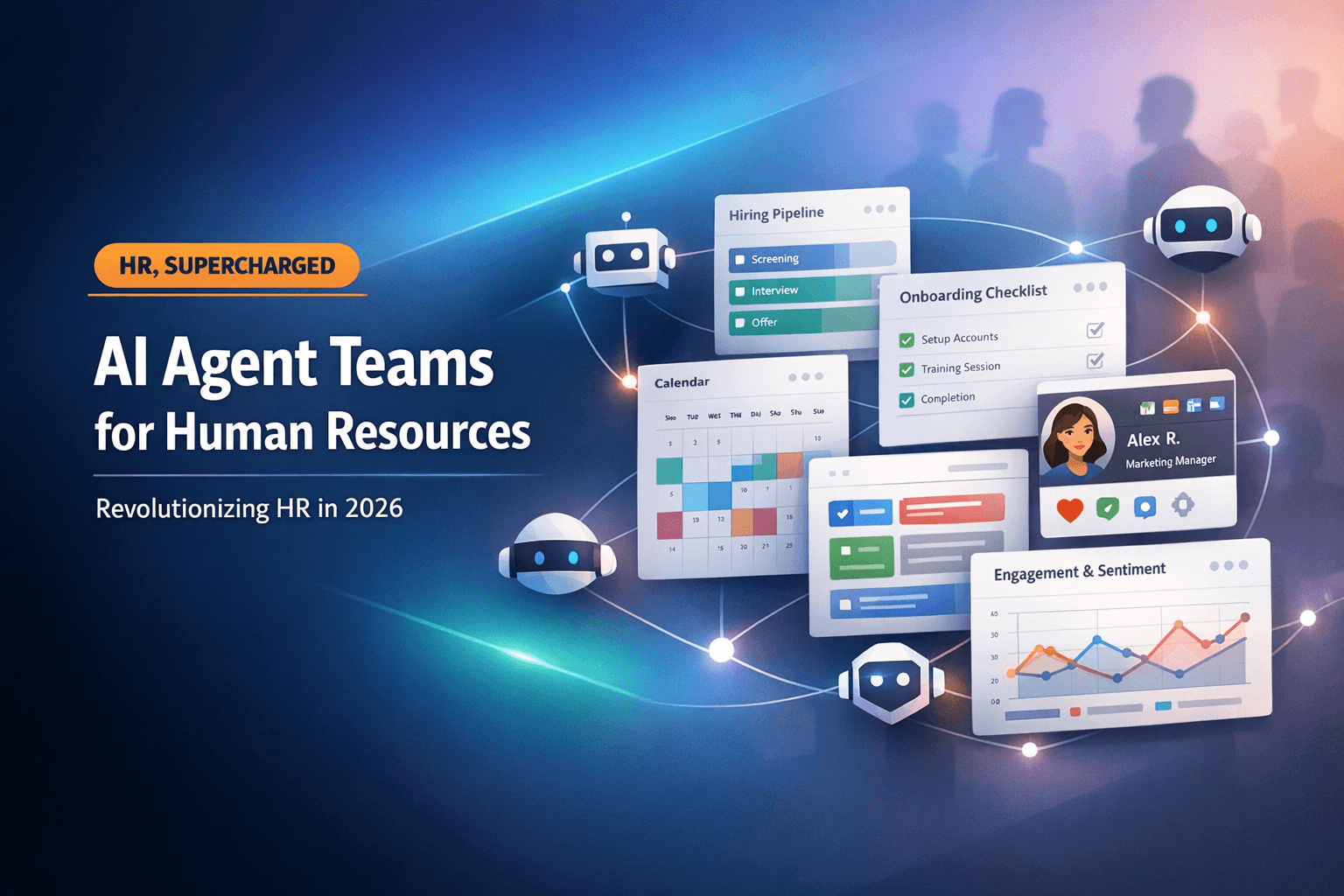
AI Agent Teams for Human Resources: Revolutionizing HR in 2026
See how AI agent teams help HR hire faster, onboard better, improve engagement, and support compliance in 2026.
HR has never been short on human work. It has always been short on time.
Recruiting, onboarding, employee questions, training reminders, policy updates, and compliance checks all compete for attention. In 2026, AI agent teams are helping HR departments manage that growing load without losing sight of what matters most: people.
This shift is bigger than simple automation. Instead of relying on one chatbot or one rules-based workflow, organizations are starting to use groups of specialized AI agents that can coordinate across tasks. One agent can screen candidates, another can guide onboarding, while a third can monitor feedback trends or flag policy risks. Together, they create a more responsive HR function that is faster, more consistent, and easier to scale.
For HR leaders, the appeal is clear. AI agent teams can reduce repetitive work, improve process visibility, and give teams more time for coaching, culture, and strategic planning. They can also create new challenges around privacy, bias, and governance, which is why thoughtful implementation matters.
What Are AI Agent Teams?
AI agent teams are groups of specialized AI systems that work together inside a shared workflow. Rather than assigning every task to a single tool, organizations can use multiple agents that each handle a specific part of the process, share context, and escalate decisions when human judgment is needed. This approach is closely related to multi-agent systems in enterprise automation.
For how planning, tool use, and handoffs work in practice, see AI agent teams in 2026: how multi-agent systems actually work.
In HR, an AI agent team might include:
- a recruiting agent that reviews applications and schedules interviews
- an onboarding agent that manages forms, reminders, and first-week tasks
- an engagement agent that analyzes surveys and employee sentiment
- a compliance agent that monitors policy workflows and reporting deadlines
- a learning agent that recommends training based on role, skill gaps, or career goals
The real advantage is not just speed. It is coordination. When these agents are designed well, they can move information from one step to the next without forcing employees or HR staff to repeat themselves. That means fewer bottlenecks, fewer dropped details, and a smoother experience across the employee lifecycle.
Where AI Agent Teams Are Making the Biggest Impact
Recruitment and Candidate Screening
Recruitment is often the first place HR teams see value. AI agents can sort applications, identify qualified candidates based on defined criteria, schedule interviews, and answer common candidate questions. Resources from LinkedIn Talent Solutions on AI in recruitment show how AI is increasingly being used to support faster, more structured hiring workflows.
Used carefully, these systems can reduce manual screening time and improve consistency in early-stage reviews. That said, they should not be treated as a substitute for human judgment. Hiring decisions still need oversight, especially when fairness, context, and candidate potential are involved.
Onboarding Automation
A good onboarding experience shapes how new hires feel about the company from day one. AI agents can help by sending paperwork, collecting signatures, assigning training, answering common questions, and reminding managers about key milestones.
This is especially useful for distributed teams or high-volume hiring. New employees get timely information, and HR teams spend less time chasing forms or repeating the same instructions.
Employee Engagement and Feedback Analysis
Engagement tends to slip when organizations only check in once or twice a year. AI agents can help HR monitor patterns in pulse surveys, support channels, and internal feedback tools, then summarize emerging themes for action. Research from Gartner on AI and employee engagement reflects the growing role of AI in helping HR teams interpret employee sentiment at scale.
The value here is not surveillance. It is visibility. When HR can spot recurring frustration, burnout signals, or communication gaps earlier, leaders can respond sooner and more thoughtfully.
Performance Management and Development
AI agents can also support performance workflows by gathering feedback, tracking development goals, and recommending learning opportunities. Instead of waiting for an annual review cycle, managers and employees can work with more continuous, structured input.
This does not make performance management fully automatic, nor should it. What it can do is reduce administrative drag and help managers focus on better conversations.
Compliance and Policy Support
HR teams are under constant pressure to stay current on policies, documentation, and reporting requirements. AI agents can assist by routing approvals, flagging missing records, organizing audit trails, and surfacing tasks that need attention.
This is one of the most practical use cases, especially in larger organizations where policy changes need to reach many teams quickly. Still, employment law and regulatory interpretation should remain in human hands, with expert review where needed.
Learning and Development Personalization
Training is more effective when it feels relevant. AI agents can recommend courses based on role, department, previous learning activity, or emerging skill needs. They can also follow up with reminders and track completion across teams.
For employees, that creates a more personal experience. For HR, it creates a clearer picture of participation, skill growth, and program effectiveness.
Why HR Teams Are Paying Attention
AI agent teams are gaining traction because they solve real operational problems.
First, they improve efficiency. HR professionals spend a surprising amount of time on coordination, follow-ups, and repetitive administrative work. For concrete examples of what agents handle well, 12 repetitive tasks you can automate with AI agents is a useful cross-functional list. Automating those tasks can free up capacity for higher-value work such as workforce planning, manager support, and employee experience design.
Second, they improve consistency. When interviews are scheduled the same way, onboarding steps are triggered on time, and training reminders go out reliably, the employee experience becomes less dependent on who remembered what.
Third, they create better decision support. AI systems can summarize patterns across hiring, engagement, learning, and retention data much faster than a human team working manually. Broader analysis from Deloitte Insights on AI in HR points to the growing role of AI in helping HR teams shift from reactive administration to more strategic planning.
Finally, they scale well. HR workloads tend to spike during growth, reorganizations, policy changes, and seasonal hiring. Agent-based workflows can absorb more of that pressure without requiring every step to be handled manually.
Challenges HR Leaders Cannot Ignore
The promise is real, but so are the risks.
Data Privacy and Security
HR systems handle some of the most sensitive information in the business. Any AI workflow that touches employee data needs strict access controls, clear retention rules, and strong security practices.
Bias and Fairness
AI can make processes more structured, but it can also repeat or amplify flawed assumptions if the underlying data or rules are biased. That is why regular audits, transparent criteria, and human review matter, especially in hiring and performance processes.
Integration With Existing Systems
Many HR teams still work across a patchwork of HRIS platforms, payroll systems, collaboration tools, and legacy databases. AI agent teams only work well when they can move information cleanly across that ecosystem.
Trust and Change Management
Employees and managers may be uneasy if they feel AI is making decisions without context or accountability. Clear communication helps. So does being honest about what the system does, what it does not do, and where people remain responsible.
Compliance Boundaries
AI can support compliance workflows, but it should not be mistaken for legal advice. Organizations still need HR, legal, and compliance leaders involved in policy interpretation and risk management.
Best Practices for Implementing AI Agent Teams in HR
The smartest rollouts usually start small.
1. Start With a Clear Use Case
Pick a process with visible friction, such as interview scheduling, onboarding paperwork, or training follow-ups. A focused pilot makes it easier to measure value and spot issues early. Practical guidance from SHRM's implementation resources on AI in HR aligns with this step-by-step approach.
2. Clean Up the Data First
AI workflows are only as strong as the data behind them. If job titles are inconsistent, records are incomplete, or process ownership is unclear, the output will suffer. Good governance is not optional.
3. Keep Humans in the Loop
AI agent teams should support HR, not operate without oversight. Set clear review points for sensitive decisions such as hiring recommendations, employee relations issues, and policy exceptions.
4. Involve More Than HR
Strong implementation usually requires input from HR, IT, legal, security, and frontline managers. Cross-functional planning helps teams avoid surprises later.
5. Measure What Matters
Track outcomes that connect to actual business and employee value. That might include time-to-fill, onboarding completion rates, manager responsiveness, training participation, or employee satisfaction with HR support.
6. Choose Tools That Fit Real Workflows
If you are evaluating platforms such as AffinityBots, look for workflow flexibility, auditability, role-based access, and the ability to integrate with the systems your HR team already uses. Fancy features matter less than a setup your team can actually trust and maintain.
What the Future Looks Like
AI agent teams are likely to become a standard part of modern HR operations, but not because they replace people. They will become standard because they make room for people to do more human work.
Over the next few years, expect three shifts.
First, HR AI will become more connected across functions. Hiring, onboarding, learning, IT setup, and finance approvals will increasingly work as one joined process instead of separate handoffs.
Second, the role of HR will continue to move upward. As routine coordination becomes easier to automate, HR leaders can spend more time on workforce strategy, leadership support, culture, and organizational design.
Third, expectations for governance will rise. Research from the McKinsey Global Institute on the future of work and AI suggests that organizations will need both stronger operating models and clearer accountability as AI becomes more embedded in daily work.
The companies that benefit most will not be the ones that automate the fastest. They will be the ones that automate carefully, communicate clearly, and keep trust at the center of the process.
Conclusion
AI agent teams are changing HR in 2026 because they address a simple reality: HR teams need better systems for handling growing complexity. When used well, these tools can speed up hiring, simplify onboarding, support employee development, and reduce routine administrative load.
But the best HR organizations will not use AI just to move faster. They will use it to create better experiences for candidates, employees, managers, and HR teams themselves.
If you are exploring AI agent teams for human resources, start with one high-friction process, define clear guardrails, and build from there. The goal is not less human HR. The goal is more time for the work only humans can do well.
Note: This article is for informational purposes only. Employment law, privacy, and compliance decisions should be reviewed by qualified legal or subject-matter experts.
FAQ: AI Agent Teams for Human Resources
What are AI agent teams in HR?
AI agent teams are groups of specialized AI systems that work together to support HR tasks such as recruiting, onboarding, employee support, learning, and compliance workflows.
How do AI agent teams improve recruitment?
They can help screen applications, schedule interviews, answer candidate questions, and keep hiring workflows moving. Human oversight is still essential for fair and informed decisions.
Can AI agent teams replace HR professionals?
No. In most organizations, their value comes from reducing repetitive work so HR professionals can focus on strategy, communication, coaching, and employee experience.
What are the biggest risks?
The biggest concerns are privacy, bias, weak data quality, poor integration, and overreliance on automation in situations that need human judgment.
What is the best place to start?
Start with a narrow pilot, such as onboarding administration or interview scheduling, then expand after you have clear results and governance in place.
Related Articles
Continue exploring more insights on human resources