Multi-Agent Workflow Handoffs That Work
Learn how to design multi-agent workflows with clean handoffs, fewer errors, and less human cleanup.
What breaks most multi-agent workflows is not the model, it’s the handoff.
One agent produces a summary. Another agent interprets it differently. A third agent politely invents missing context and sends the wrong thing to the wrong system. That is how “automation” quietly becomes a cleanup job for humans. The timing matters because agent adoption is no longer niche: McKinsey’s 2025 State of AI found that 23% of organizations are already scaling agentic AI in at least one business function, while another 39% are experimenting with AI agents. Meanwhile, Salesforce’s 2026 State of Sales report says 54% of sellers have already used AI agents, and top performers are 1.7x more likely to use them.
So yes, the bots are showing up to work. The question is whether they can pass each other the ball without punting it into finance.
Don’t optimize the agents first, design the contract between them
In practice, teams spend too much time tuning prompts and not enough time defining handoff contracts.
A clean handoff is not “Agent A sends something to Agent B.” It is a structured transfer with explicit rules: what was received, what was decided, what remains uncertain, and what action is allowed next. If that sounds boring, good. Boring is what you want between autonomous systems.
We’ve found every handoff should specify five things:
- Input format
- Decision rights
- Required evidence
- Output schema
- Failure path
If you skip even one, the next agent starts guessing.
Here’s the simplest version:
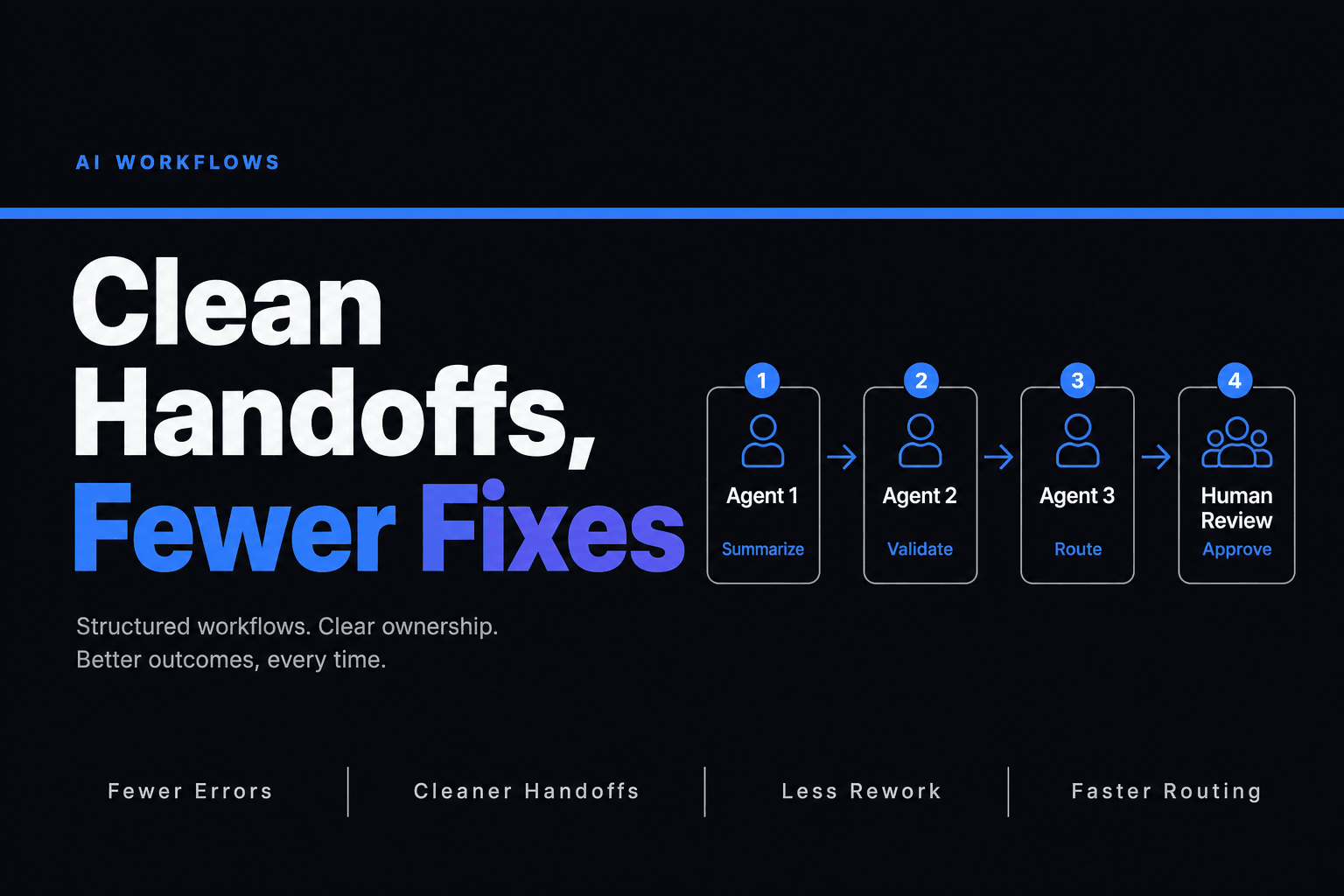
Trigger -> Agent A classifies -> Handoff packet -> Agent B acts -> Human review or system write
The packet matters more than the prose. For example, a lead-qualification agent should not hand off “looks promising.” It should hand off something like this:
lead_score: 82
segment: mid-market SaaS
intent_signal: requested demo + pricing
required_next_step: SDR outreach within 15 minutes
missing_fields: employee_count
confidence: high
approved_actions: send_email, create_crm_task
blocked_actions: discount_offer, meeting_reschedule
That structure is what keeps the next agent from improvising policy. If you want a deeper look at where agent systems go sideways, 9 mistakes to avoid when designing AI agents for business workflows pairs well with this, especially if your team is still mixing “smart prompt” thinking with actual workflow design.
If the next agent has to infer intent, your handoff already failed
This is the ugly truth. Most multi-agent failures are really context failures wearing a model-shaped disguise.
IBM’s April 2026 analysis on why AI systems fail in the real world argues that the core issue is not model sophistication, but the system’s inability to operate inside enterprise context. That tracks with what we see. Agent B usually doesn’t fail because it is dumb. It fails because Agent A handed over partial context, missing constraints, or ambiguous authority.
A clean handoff should answer questions before the next agent has to ask them:
What does this item actually mean?
“Support ticket” is not enough. Is it a billing complaint, outage report, churn risk, or feature request?
What is the next agent allowed to do?
Can it draft? Can it send? Can it update a CRM record? Can it touch a live customer account? Those are very different risk levels.
What should happen if confidence is low?
If the answer is “the agent should do its best,” congratulations, you have invented chaos.
This is where retrieval helps. If you’re grounding agents on docs, policies, and prior records, the handoff should include the specific retrieved facts that informed the decision, not just the final recommendation. That is one reason combining RAG with reasoning produces more reliable behavior than letting each agent rediscover the world from scratch.
A good handoff reduces re-interpretation. A bad one creates telephone-game automation.
The cleanest workflows are slightly repetitive on purpose
People love elegant automation diagrams. We love them too. Then production happens.
What actually works is a little more repetitive than most teams expect. Redundant checks, repeated IDs, explicit statuses, and “are we still talking about the same object?” validations feel clunky until they save you from a destructive write.
We usually recommend these guardrails between agents:
- Stable object IDs across every step
- Status fields instead of free-text progress notes
- Confidence thresholds that trigger review
- Allowed action lists instead of open-ended tool access
- Timeout and retry rules for external dependencies
That last one matters more than people admit. IBM’s April 2026 piece on stalled enterprise AI projects makes the same point from a scaling perspective: systems often work in isolation, then break when they hit messy operational dependencies. The model may perform fine. The workflow still fails.
A practical example:
| Handoff field | Weak version | Clean version |
|---|---|---|
| Customer identity | "Acme account" | account_id: 48392 |
| Priority | "Urgent" | priority: P1, reason: outage, SLA_minutes: 30 |
| Recommended action | "Follow up fast" | create_ticket, page_on_call, draft_customer_reply |
| Context | One-paragraph summary | Structured facts + cited source records |
| Failure handling | None | Escalate to human after 2 failed attempts |
Yes, this is less glamorous than “AI coworkers collaborating seamlessly.” It is also how you avoid waking up to 47 duplicate CRM tasks.
The highest-friction handoff is usually between reasoning and action
The most dangerous moment in a multi-agent workflow is not agent-to-agent messaging. It is the jump from analysis to action.
One agent researches. Another decides. Then a third writes to a system, sends an email, updates a record, or triggers a downstream process. That final step is where vague instructions become expensive.
This is especially relevant in sales and support, where timing and execution both matter. In Salesforce’s 2026 State of Sales report, sellers said agents are expected to cut research time by 34% and content creation time by 36%. Great. But faster research only matters if the action agent receives a handoff it can execute safely and immediately.
We’ve found the transition works best when you split the workflow into three roles:
- Research agent: gathers facts, enriches data, flags uncertainty
- Decision agent: applies rules, policy, and prioritization
- Execution agent: performs only approved actions in approved systems
That separation feels slower on a whiteboard. In reality, it is faster because each agent has a smaller surface area for mistakes.
If you’re building this in AffinityBots, that maps naturally to agents with scoped tools and knowledge, wired into one unified workflow where each task has a clear role. You can keep the research agent connected to knowledge sources, restrict the execution agent to specific integrations, and start the whole run from a form, webhook, schedule, or manual trigger depending on the use case. That is the difference between an impressive demo and something you can actually trust on Tuesday morning.
Here’s the contrarian bit: more autonomy usually makes handoffs worse
The internet loves the phrase “fully autonomous.” Operations teams usually do not.
Gartner said in its September 30, 2025 survey that only 15% of IT application leaders were considering, piloting, or deploying fully autonomous AI agents, and just 14% strongly agreed they had alignment across IT, business users, and leadership on what problems AI should solve, according to the Gartner 2025 autonomous agents survey. That gap is the story.
More autonomy sounds sophisticated, but clean handoffs usually come from tighter boundaries, not looser ones.
A few rules we use:
- Let agents recommend more often than they commit
- Give only one agent per workflow the right to perform a sensitive system write
- Treat missing fields as a routing event, not an invitation to improvise
- Make human review a designed checkpoint, not an apology after the fact
This is also why agents versus workflows is the wrong debate. You need both. The agent handles judgment inside a bounded task. The workflow handles sequencing, permissions, and handoffs so that judgment does not spill everywhere.
In other words, autonomy is useful. Unbounded autonomy is just expensive confidence.
Measure handoff quality like an operator, not a prompt engineer
If you cannot measure handoff quality, you will end up measuring vibes.
Most teams track overall success rates. That is too coarse. You need metrics tied to the transfer points, because that is where compound failures start.
We recommend monitoring:
- Handoff completion rate
- Percent of handoffs needing human correction
- Retry rate by downstream tool
- Time from handoff to completed action
- Schema violation rate
- Duplicate action rate
- Confidence-to-error correlation
A simple scorecard is enough:
Handoff Health Score =
(valid schema %) +
(action success %) -
(human correction %) -
(duplicate actions %)
If the score drops, inspect the packet, not just the prompt.
This is where platforms matter. AffinityBots records workflow runs and per-task execution history, so you can inspect what happened at each step instead of guessing from a final output blob. That’s crucial when a manager-style workflow delegates work across multiple agents and you need to see where the chain bent. If you want examples of how these patterns show up in the wild, AI agent teams in 2026 and harnessing agentic AI for business are good next reads.
Clean handoffs are not a prompt-writing achievement. They are an operational design achievement.
If you’re building multi-agent systems and want them to behave like a real team instead of a very fast misunderstanding machine, design the handoff first. In AffinityBots, that means creating agents with scoped tools and knowledge, then wiring them into a workflow with explicit tasks, controlled triggers, and visible run history. Start with one workflow where the transfer between agents actually matters, like lead qualification to outreach or intake triage to execution. Then make the packet boring, explicit, and inspectable.
That is how handoffs stop being the failure point and start becoming the part that scales.
Related Articles
Continue exploring more insights on artificial intelligence