AI Agent Handoffs: A Complete Technical Breakdown of How Work Moves Between Specialized Agents
Learn how AI agent handoffs transfer state, authority, and constraints, plus how to test routing, delegation, and approvals.
What You’ll Learn
- What an AI agent handoff actually transfers, beyond a chat transcript
- How to design a handoff contract with state, authority, constraints, and stop conditions
- When to use routing, delegation, parallel work, or a human approval gate
- Why agent teams get stuck in loops, drop context, and confidently escalate nonsense
- How to trace, test, and improve handoffs before they become expensive production folklore
Shipping a three-agent demo is no longer the hard part. One agent researches, another drafts, a third checks the result, and the room is happy because nothing irreversible has happened yet. Production is less forgiving. A live request shows up with a partial CRM record, an exception buried in an SOP, and an action that cannot be undone.
That is where handoffs either earn their keep or become a hallway of excuses.
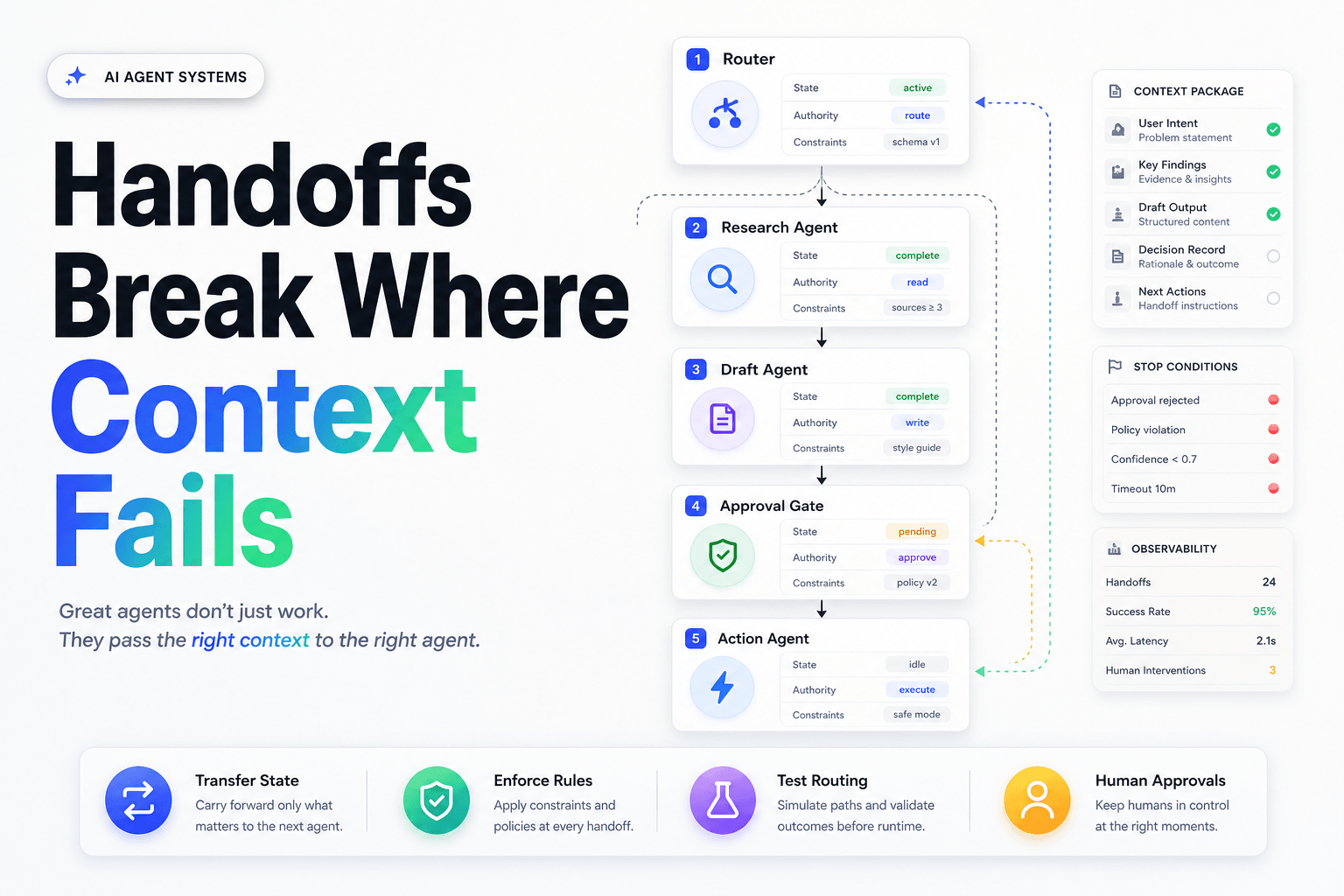
A handoff is the moment one agent transfers responsibility for a piece of work to another specialist, along with enough verified context for that specialist to act. It may look like a message, a tool call, a queue event, or a protocol task. Operationally, it is a change in authority.
That distinction matters. In Caylent’s August 2026 survey of 200 senior enterprise leaders, 59.5% said their organizations were already running AI agents autonomously in production, yet only 23.5% reported those agents were broadly deployed beyond initial pilots. Caylent’s 2026 Enterprise Readiness for Agentic Engineering survey points to the gap most teams eventually discover: getting agents into production is easy; deciding how much authority they get, and making a chain of them behave predictably, is the job. (caylent.com)
A handoff is a transfer of authority, not a copy-paste job
A transcript tells the next agent what was said. A proper handoff tells it what is true, what remains unknown, what it is allowed to do, and what must happen next.
That is much more useful.
The receiving agent needs a job, not a novel
The fastest way to ruin a multi-agent workflow is dumping every prior message into the next agent’s context window and asking it to “take it from here.” The receiver has to reconstruct the problem, infer the current status, and decide whether the prior agent did anything reliable.
Instead, pass a compact work packet.
For example, a support triage agent handling a delayed shipment should not send a 40-message conversation to a billing agent. It should send the account ID, affected order IDs, verified shipment status, customer sentiment, relevant policy clause, requested outcome, and an explicit action request such as check_duplicate_charge.
The billing agent is now a specialist with a clear assignment. It does not need to play detective before doing finance work.
Authority must move with the task
Different handoffs move different levels of control:
Handoff typeWhat movesBest useAdvisoryFindings only, original agent stays in chargeResearch, policy lookup, classificationDelegated taskA scoped task and required inputsEnrichment, document review, calculationsControl transferConversation and next-step ownershipCustomer-facing support or sales routingEscalationEvidence package and approval requestRefunds, compliance, account changes
OpenAI’s guidance describes a direct agent handoff as a one-way transfer that starts the receiving agent and carries forward the latest conversation state. OpenAI’s practical guide to building agents makes an important technical point: direct handoffs work when another agent genuinely needs to take over the interaction, not merely contribute a fact. (openai.com)
In practice, we reserve control transfers for conversations that need a different owner. For everything else, a manager agent should call a specialist, receive a structured result, and retain responsibility for what happens next.
That keeps the workflow from turning into an agent version of “I’ve forwarded your email to the appropriate department.”
Context has a half-life
Not every fact belongs in every handoff.
Customer name and open ticket ID may be essential. A stale summary from last quarter is not. Internal reasoning text, raw hidden prompts, and tool credentials should never hitch a ride just because they happen to be nearby.
Treat context like luggage on a tight connection. Bring what the next agent needs. Leave the kitchen sink at home.
If the receiving agent has to guess, the contract already failed
A handoff contract is a structured agreement between the sending and receiving agents. It defines inputs, outputs, permissions, validation rules, and the conditions under which the receiver should return, escalate, or stop.
Without one, every specialist starts improvising.
Build the contract around decisions
A useful contract is not a verbose prompt template. It is a machine-checkable object that answers five questions:
- What is the task?
- Which facts have been verified?
- Which action is the receiver allowed to take?
- What output format is required?
- What should happen if confidence is low or data is missing?
Here is a simplified example for a refund-review handoff:
{
  "handoff_id": "hf_84219",
  "task_type": "refund_eligibility_review",
  "case_id": "SUP-10927",
  "verified_facts": {
    "order_id": "ORD-7781",
    "purchase_date": "2026-08-02",
    "delivery_status": "delivered",
    "refund_requested_usd": 249.00,
    "policy_version": "refund-policy-2026-07"
  },
  "constraints": {
    "max_refund_without_human_approval_usd": 75,
    "may_not_issue_refund": true
  },
  "required_output": {
    "decision": "eligible | ineligible | needs_review",
    "reason_codes": [],
    "evidence_links": [],
    "recommended_next_step": ""
  },
  "return_conditions": [
    "missing_order_record",
    "policy_conflict",
    "customer_threatens_chargeback"
  ]
}
This looks unglamorous because it is. Good operations often are.
The contract gives the reviewer enough information to make a decision without handing it permission to issue money. That boundary is deliberate.
Separate evidence from interpretation
One agent may conclude that a customer is “likely eligible.” Another agent should not treat that phrase as a fact.
We use separate fields for:
verified_facts: records retrieved from systems of recordderived_assessment: classification, recommendation, or scoreunknowns: missing information that blocks a decisionprovenance: where each material fact came from
That separation prevents a common failure: an early agent makes a reasonable guess, later agents repeat it, and by the final step the guess has achieved the social status of a database field.
If your source material is messy, fix that before expecting clean handoffs. Teams building agent workflows from internal procedures should first turn company SOPs into AI-ready knowledge, with named owners, clear exceptions, and stable references rather than a folder of policy PDFs from three reorganizations ago.
Use schemas as brakes, not decoration
Schema validation catches boring failures before they become customer-facing ones:
- an order ID is missing
- a date is malformed
- the routing agent labels a case
billingbut requests technical diagnostics - the receiving agent returns prose when downstream automation requires a decision code
- an approval-required action is marked complete
We have found that handoff schemas should be strict around identifiers, amounts, permissions, and status. They can be looser around summaries and language. A workflow does not need an argument about whether a summary is 87 or 103 words long. It does need to know whether the agent is about to refund $2,500.
Branching works only when the router can say no
Routing is where many agent systems become overconfident. A manager agent is asked to select the “best” specialist, so it selects one. Every time. Even when the request is incomplete, multi-domain, or plainly weird.
A good router must be allowed to decline the premise.
Start with deterministic branches
Use code or business rules for facts that are not ambiguous:
- refund amount exceeds the approval threshold
- account belongs to an enterprise tier
- customer is in a regulated jurisdiction
- ticket includes a security keyword
- record is missing a required identifier
Let the model handle fuzzy classification, intent extraction, and prioritization. Let deterministic logic handle thresholds, permissions, and rules that auditors may eventually read.
Google’s Agent2Agent protocol formalizes this idea at a broader level. An A2A task has a lifecycle, status updates, messages, and output artifacts, allowing agents to collaborate without sharing every tool or memory store. Google’s April 2025 Agent2Agent protocol announcement describes the task object and artifact model that makes these boundaries explicit. (developers.googleblog.com)
Route by confidence and consequence
A 70% confidence classification might be fine for assigning a low-priority newsletter request. It is a lousy basis for changing a customer’s account access.
Use two variables:
IF consequence = high
  AND confidence < 0.95
THEN human_review

ELSE IF required_data_missing = true
THEN request_information

ELSE IF category_confidence >= 0.80
THEN route_to_specialist

ELSE
  send_to_generalist_with_review_flag
The exact thresholds will vary. The discipline should not.
Higher consequence means a lower tolerance for ambiguity. That is why a support agent may draft a response with partial context, while a finance agent should refuse to create a credit memo until key fields are verified.
Avoid the “specialist ping-pong” branch
Here is the familiar disaster:
- Triage sends a ticket to Billing.
- Billing notices a delivery problem and sends it to Logistics.
- Logistics finds a duplicate charge and returns it to Billing.
- Billing asks Triage to clarify the customer’s intent.
- Somewhere, a customer opens a second ticket.
Prevent this with a case owner and a handoff budget.
Assign one agent, usually a manager or case coordinator, as the owner of workflow state. Specialists may return artifacts and recommendations, but they should not freely reroute work unless the workflow explicitly grants that ability.
Then set limits:
- maximum two specialist delegations before review
- no agent can hand work back to its direct sender without a new fact
- each return must include a structured blocker code
- repeated task types trigger an escalation, not another attempt
That is less “autonomous.” It is also how you avoid a tiny committee meeting happening at API speed.
Put humans at irreversible boundaries, not every boundary
Human-in-the-loop design is often treated like a panic button. In a well-built workflow, it is a targeted control.
You do not need a person to approve every classification, summary, or internal note. You do need a person when the workflow crosses a boundary with financial, legal, reputational, or security consequences.
Approval should receive a decision packet
Never make a human reviewer reconstruct the whole workflow.
An approval handoff should include:
- recommended action
- customer or business impact
- policy or rule that applies
- verified evidence
- alternatives considered
- deadline or urgency
- the exact action that will occur after approval
For a refund exception, the approver should see “Issue $250 credit because shipment was lost, inventory is unavailable, customer has contacted support twice, policy exception code 4.2 applies.” Not “Please review this ticket.”
For practical configuration patterns, see how to set up AI approval gates for refunds, escalations, and sensitive actions. The central idea is simple: approvals should be designed as workflow states with explicit post-approval actions, not as a Slack message someone might answer after lunch.
An escalation must preserve the customer’s momentum
A human escalation should never reset the case to zero.
The support team at RB2B reported that its AI-first support system automatically resolved 65% of inquiries and saved more than 132 hours per month. Intercom’s March 2025 RB2B case study is useful here because the benefit did not come from pretending every request was simple. It came from handling repetitive work consistently, leaving people with the cases that needed judgment. (intercom.com)
When a human receives an escalated case, they should inherit the case brief, retrieved evidence, failed checks, and customer-facing draft. They should not inherit a shrug.
Review sampled low-risk work too
High-risk approval gates catch expensive errors. Sampling catches slow quality drift.
Review a percentage of routine handoffs each week, especially those marked successful. Look for:
- incorrect routing that happened to produce an acceptable answer
- agents using stale policy versions
- recurring missing fields
- a specialist that never returns
needs_review - tools called when a structured record would have been enough
The quiet errors are usually the ones that mature into system behavior.
The most popular handoff pattern can create a very polite failure loop
More agents do not automatically mean better work.
Sometimes a single capable agent with a few well-defined tools beats a three-agent chain with a manager, reviewer, and “senior strategic synthesis specialist” who has somehow added 14 seconds and zero facts.
Agent washing has made the architecture noisier
Gartner predicted in June 2025 that more than 40% of agentic AI projects would be canceled by the end of 2027, citing escalating costs, unclear business value, and inadequate risk controls. Its survey also found that only 19% of respondents had made significant investments in agentic AI. Gartner’s 2025 agentic AI forecast is a useful antidote to the “every workflow needs a swarm” sales pitch. (gartner.com)
The contrarian view is straightforward: many handoffs are unnecessary.
If a task has a fixed sequence, clear inputs, and one tool boundary, build a workflow with deterministic steps. Do not invent specialized agents because a diagram with circles looks futuristic in a pitch deck.
Handoff loops usually begin with vague exits
A specialist should never return “I need more information” without specifying:
- what information is missing
- who can provide it
- whether it is mandatory
- what decision is blocked
- when the case should expire or escalate
Use typed blocker codes such as MISSING_ACCOUNT_ID, CONFLICTING_POLICY, TOOL_TIMEOUT, or OUT_OF_SCOPE_REQUEST.
That turns a vague dead end into a routable state.
Context bloat is a silent cost multiplier
Passing full chat histories, retrieval results, tool responses, and scratch notes to every downstream agent inflates latency and model spend. It also raises the odds that a receiving agent latches onto an outdated detail.
Summarize at boundaries. Preserve source links and record IDs for auditability. Retrieve deeper context only when the receiving agent needs it.
The best handoff is often smaller than teams expect.
Trace the baton, not just the final answer
A polished final response can hide three bad routing decisions, two tool failures, and a reviewer that quietly contradicted the policy.
That is why observability has become a production requirement rather than an engineering luxury.
Every handoff needs an ID
Assign a trace_id for the full workflow and a handoff_id for every authority change or delegated task. Capture:
- sending agent and receiving agent
- timestamp and latency
- task type
- contract version
- input schema validation result
- tools called by the receiver
- outcome status
- reason for escalation, retry, or rejection
LangChain’s 2026 survey of more than 1,300 professionals found that 89% of organizations had implemented some form of agent observability, while 62% had detailed tracing at the step and tool-call level. LangChain’s State of Agent Engineering 2026 shows where mature teams are spending attention: not on prettier demos, but on finding out why a run behaved the way it did. (langchain.com)
Measure the handoff, not only end-to-end success
Track a scorecard like this:
handoff_acceptance_rate     = accepted contracts / total handoffs
first_pass_completion_rate  = completed without return or escalation
handoff_rework_rate         = cases reopened after specialist completion
routing_accuracy             = correctly routed cases / audited cases
context_defect_rate          = handoffs missing required facts / total
human_override_rate          = approvals changed by reviewer / approvals
median_handoff_latency       = p50 elapsed time between send and accept
A 95% final-resolution rate can hide a 30% rework rate if humans are quietly repairing agent mistakes downstream. Measure both.
Turn failures into regression tests
When a handoff fails, do not just patch the prompt and hope.
Save the case as a test fixture. Include the original input, expected route, valid evidence fields, prohibited actions, and desired outcome. Then rerun it whenever you change prompts, tools, models, policies, or schemas.
Anthropic’s 2026 guidance on agent evaluations recommends using production failures to build repeatable test coverage, because multi-turn systems can regress in ways that a single output check will miss. Anthropic’s guide to evaluating AI agents makes the point plainly: evaluating an agent means evaluating its actions, state changes, and decisions across the run. (anthropic.com)
A refund request is the best handoff stress test
Take a request that sounds simple: “My order arrived late, I was charged twice, and I want a refund.”
It is actually three workstreams with different permissions.
The workflow should split facts from actions
A reliable flow might look like this:
Intake Agent
  -> extracts order ID, customer ID, requested outcome, urgency

Case Manager
  -> verifies identity and creates case state

Billing Specialist
  -> checks duplicate charge and payment status

Logistics Specialist
  -> checks carrier event history and delivery exception

Policy Reviewer
  -> evaluates eligibility using verified facts only

Approval Gate
  -> required if refund exceeds threshold or policy exception applies

Response Agent
  -> drafts a customer reply from approved actions and evidence
The case manager stays responsible for the whole request. Billing and logistics contribute evidence. The policy reviewer determines eligibility. The response agent never invents a remedy, because it only receives approved actions.
That separation is the whole trick.
Each handoff should have one reason to exist
The billing specialist gets payment facts. The logistics specialist gets delivery facts. Neither should write the final customer response.
By narrowing each assignment, you make errors legible. If the customer receives the wrong amount, inspect the billing contract. If the wrong policy is applied, inspect the reviewer’s retrieval and policy version. If the reply sounds tone-deaf, inspect the response agent.
For more implementation detail on roles, state, and clean specialist boundaries, our guide to designing multi-agent workflows with clean handoffs goes deeper on the operating patterns that keep delegated work from becoming ambiguous.
The final response should be downstream of proof
A response agent should receive an action record like:
approved_action: issue_partial_refund
approved_amount: 75.00
expected_timing: 3_to_5_business_days
shipment_status: delivered_late
duplicate_charge_status: reversed
required_disclosure: refund_timing_policy_v3
Now it can write a clear reply without reasoning about policy, touching financial systems, or guessing what happened.
That is a clean handoff. The customer gets an answer. The team gets an audit trail. Nobody has to explain why a language model became temporary CFO.
Key Takeaways
- A handoff changes responsibility. Treat it as a contract, not a conversational flourish.
- Pass verified facts, constraints, provenance, and a defined output schema. Do not pass a mystery pile of chat history.
- Keep one agent accountable for workflow state, even when specialists contribute work.
- Use deterministic rules for permissions, thresholds, and hard business constraints.
- Put human approval at irreversible actions, then give reviewers a decision packet instead of a scavenger hunt.
- Trace every handoff, measure rework, and turn production failures into test cases.
- Build fewer handoffs than your architecture diagram wants. Each one needs to justify its latency, cost, and failure surface.
Agent handoffs are where an AI workflow stops being a collection of clever prompts and starts acting like an operating system for work.
Build them with explicit contracts, typed states, controlled branching, and human gates where consequences demand them. Then inspect the traces ruthlessly. A workflow that can explain how work moved is one you can improve.
AffinityBots gives teams the building blocks to create specialized agents, connect them into dynamic workflows, expose execution traces, and add approval paths before sensitive actions occur. Build your next agent team in AffinityBots with handoffs that carry evidence, not excuses.
Related Articles
Continue exploring more insights on artificial intelligence