How to Turn Company SOPs Into AI-Ready Knowledge That Agents Can Actually Use
Learn how to convert company SOPs into AI-ready knowledge so agents can follow procedures accurately, safely, and at scale.
Most SOPs were written for a tired human at 4:47 p.m., not an AI agent making a decision in 400 milliseconds.
That distinction matters. A human can infer what “review as needed” means, notice that a policy is six months old, and message the operations lead when the customer’s situation gets weird. An agent sees vague wording, missing conditions, conflicting files, and a very real chance to do exactly what it was told, just not what anyone meant.
The gap is already showing up in production. In Box’s 2026 enterprise AI research, 96% of organizations said access to company-specific content matters for agents, yet only 36% had connected agents to trusted internal content across many use cases in Box’s State of AI in the Enterprise report. Your SOP library may be valuable. That does not automatically make it usable.
Here’s how to turn company procedures into AI-ready knowledge that agents can follow, test, and improve without treating your shared drive like a bag of mystery cables.
Your SOP is probably a training artifact, not an executable instruction
A traditional SOP usually explains a process after the fact. It tells a new hire what good work looks like, gives a few screenshots, and hopes they absorb the unwritten rules through repetition and mild panic.
Agents need a different artifact.
They need instructions that make the boundaries of the job explicit: what starts the process, what information is required, which decision rules apply, what action is permitted, and when the task must stop. “Process refunds according to policy” is training material. “Approve refunds under $100 only when the order is within 30 days, the reason code is eligible, and no prior exception exists” is an operational rule.
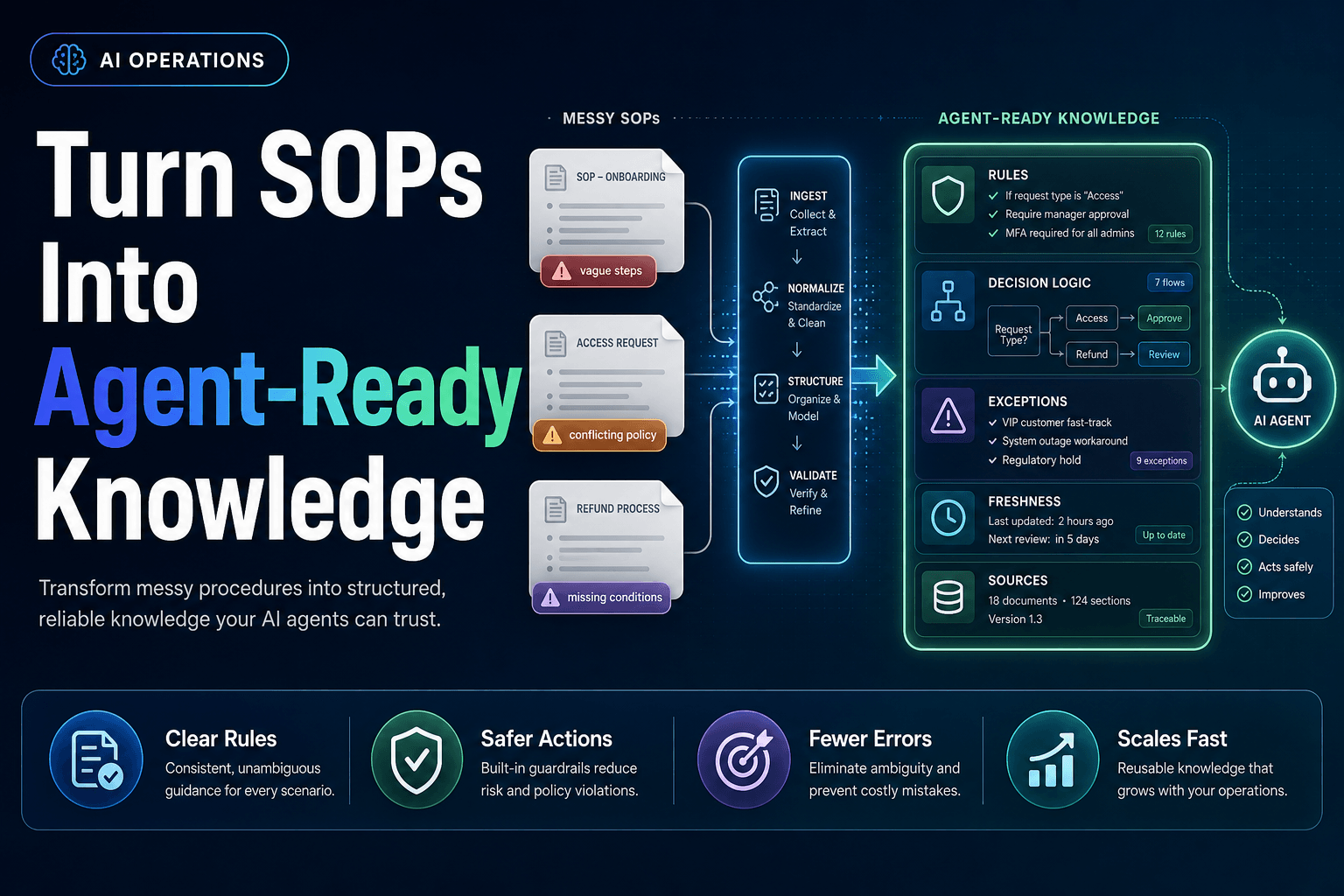
We’ve found that one mature SOP often becomes four smaller AI-ready assets:
- A plain-language overview for context.
- A decision policy with rules, thresholds, and exceptions.
- A tool-action guide defining what the agent can read, draft, update, or send.
- A test pack with normal cases, edge cases, and hard-stop scenarios.
That split feels fussy at first. It saves hours later.
Consider a customer address-change SOP. The original document may say, “Verify identity before updating shipping information.” An AI-ready version must answer questions the original skipped:
- Which identity signals count?
- Is an email-match enough, or is a one-time code required?
- Can the agent update an address after an order has shipped?
- What gets logged?
- When does the case move to a human queue?
If the procedure cannot answer those questions, the agent should not improvise. It should escalate.
For a deeper look at the workflow side of this work, AI-first workflows are useful because they force teams to define inputs, handoffs, and measurable outcomes before they add automation.
Stop turning 12-page procedures into one giant RAG blob
The popular move is simple: upload every SOP, point retrieval at the folder, and declare the knowledge base “AI-ready.” Then the agent retrieves paragraph 14 from a 2023 procedure, paragraph 3 from an updated policy, and a cheerful sentence from an onboarding deck. Confidence remains high. Accuracy does not.
Messy source material is not a minor inconvenience. In a 2025 survey of 401 data leaders, 42% said more than half of their AI projects had been delayed, underperformed, or failed because of data-readiness issues, according to the Fivetran AI and Data Readiness Survey.
RAG is helpful. It is not a cleanup crew.
Instead of feeding an agent one monolithic document, break procedures into retrievable units that each answer one job-specific question. A useful unit is usually 150 to 400 words, but size is not the deciding factor. Decision completeness is.
| SOP component | What the agent needs | Example |
|---|---|---|
| Trigger | The event that starts work | “A refund request arrives through the support form” |
| Required facts | Fields the agent must verify | Order date, order value, reason code, payment status |
| Decision rule | A condition with an outcome | “If order value exceeds $100, request approval” |
| Action | Allowed system behavior | Create draft refund, do not submit |
| Exception | A hard stop or escalation path | Fraud flag, chargeback, regulated product |
Give each unit a clear title, owner, effective date, business function, and related system. “Returns Policy” is a poor retrieval label. “Refund approval rules for U.S. direct-to-consumer orders under $100” is much better.
The unglamorous work wins here: delete duplicates, retire stale versions, and identify which document actually controls the decision. A polished agent cannot rescue three competing definitions of “eligible customer.”
Put the decision logic where the agent can see it
Most SOPs bury the important bits inside prose. A sentence such as “Customer success should use judgment when considering a goodwill credit” may work for an experienced manager. It gives an agent almost nothing to operate on.
Turn judgment-heavy language into an explicit policy matrix.
For example, a SaaS company handling cancellation requests could define:
- A $25 goodwill credit is allowed when a billing error is confirmed and the account has fewer than two prior credits.
- A credit between $26 and $100 requires team-lead approval.
- A cancellation involving an annual contract, chargeback, or legal complaint must be assigned to a specialist.
- The agent may draft the explanation, but it may not submit the credit.
Notice what changed. The agent is no longer asked to “be reasonable.” It is asked to classify facts, apply rules, and stop at boundaries.
This is also where teams should separate knowledge from authority. An agent may know the full refund policy while having permission only to prepare a case summary. That distinction prevents the classic automation mistake: granting action rights just because the system can explain the procedure.
When procedures feed multi-step systems, structured handoffs matter just as much. A triage agent should pass a short, machine-readable record to the next agent:
case_type: billing_error
customer_tier: enterprise
requested_credit: 75
prior_credits_12mo: 1
recommended_action: manager_approval
evidence: invoice_8392, payment_log_284
That is far safer than handing the next agent six paragraphs of conversational notes and wishing it luck. Our guide to clean multi-agent workflow handoffs shows how to carry the right facts forward without carrying every stray thought too.
Let the agent ask questions only where ambiguity pays
Teams often treat clarifying questions as a failure. They are usually a sign that the system has found a genuine gap in the procedure.
Still, an agent that asks four questions before routing a basic password reset becomes a tiny bureaucrat. The trick is deciding which uncertainty is worth resolving.
We use three buckets:
- Safe uncertainty: The agent can choose a default. Example: categorizing a non-urgent internal request as “general operations.”
- Recoverable uncertainty: The agent can prepare work but cannot finalize it. Example: drafting a customer response when account ownership is unclear.
- Costly uncertainty: The agent must stop. Example: changing bank details, approving a contract exception, or disclosing sensitive account information.
For a hiring workflow, an agent may safely summarize an applicant’s portfolio. It should not decide whether an immigration-related work authorization issue is acceptable. For accounts payable, it may match an invoice number and purchase order. It should not release a payment when the vendor bank account changed within the past seven days.
Those boundaries belong in the SOP itself, not hidden in a prompt someone wrote during a late-night pilot.
A practical rule: define an escalation trigger whenever the cost of a wrong action exceeds the cost of a 10-minute delay. That one sentence gets teams out of abstract “human in the loop” debates and into useful operating design. For the mechanics, see how to build a human-in-the-loop AI workflow.
Versioning beats “one source of truth” theater
“One source of truth” sounds wonderful until finance updates a policy in one system, support has an approved exception in another, and the agent retrieves both.
The fix is not a grand knowledge-management project with 14 committees. Start by treating high-impact SOPs like production assets.
Every AI-ready procedure should have:
- A named business owner who approves policy changes.
- An effective date and a review date.
- A version ID that appears in the agent’s output or execution log.
- A small test set of expected decisions.
- A retirement rule for superseded procedures.
The test set is the bit teams skip. Don’t.
For a lead-routing SOP, build 20 realistic records: a clean enterprise fit, a student request, a duplicate contact, a competitor inquiry, a high-intent prospect with missing phone data, and so on. Run those records every time the policy or prompt changes. If the agent suddenly routes a strategic account to a generic nurture sequence, you catch the problem before sales does.
Quality has become the operational blocker. In LangChain’s June 2026 survey of more than 1,300 professionals, 32% named quality as the top barrier to production agents, while 89% reported using observability in some form in the State of Agent Engineering report. Logging is not just for debugging model behavior. It proves which policy version produced which decision.
That trail becomes especially useful when a reviewer says, “Why did it do that?” Fair question.
Measure whether the agent follows the SOP, not whether it sounds confident
A charming answer can still be wrong. In practice, SOP conversion should be measured like process quality, not content quality.
Build a scorecard before you let the agent touch live work:
| Metric | What it reveals | Practical target |
|---|---|---|
| Rule adherence | Did it follow the documented policy? | 95%+ on approved test cases |
| Escalation precision | Did it stop on the right edge cases? | Fewer than 2 missed hard stops per 100 cases |
| Evidence completeness | Did it attach the facts behind its decision? | Required evidence present in 100% of actions |
| Reviewer edit rate | How often did a human change the output? | Declining week over week |
Start with a process where decisions repeat often enough to learn from, but the blast radius stays low. Think internal IT access requests, standard vendor questionnaires, routine customer updates, or content compliance checks. A once-a-quarter executive exception process is not where you want to discover that “reasonable judgment” has 11 interpretations.
This focus on workflow redesign is not academic. McKinsey’s 2025 global survey found that 23% of respondents were scaling an agentic AI system somewhere in their organization, while another 39% were experimenting, and it identified workflow redesign as a major success factor in the McKinsey State of AI 2025 survey.
An AI-ready SOP gives agents a job they can actually perform, gives reviewers a standard they can enforce, and gives the business a way to improve the process without guessing.
The goal is not to convert every policy document this quarter. Pick one procedure that creates recurring friction, turn its hidden judgment calls into visible rules, test it against real cases, and give the agent only the access it needs. AffinityBots lets teams build that controlled path with specialized agents, shared context, tool permissions, workflow traces, and review points, so your SOPs become working operations instead of expensive digital wallpaper.
Related Articles
Continue exploring more insights on artificial intelligence